
Centralized Air Purification Systems: HEPA, UV-C & Multi-Layer Air Quality Control
A centralized air purification system integrates particulate filtration, pathogen inactivation, and gas/odor control into a facility’s main HVAC system — treating air for an entire building or zone rather than relying on standalone portable units scattered through the space. For healthcare facilities, pharmaceutical cleanrooms, and any large commercial or industrial space serious about indoor air quality, understanding what each purification technology actually does — and doesn’t do — is the difference between a system that performs and one that provides false reassurance. This guide covers the core technologies, how filtration grades are actually classified, what a genuine cost-of-ownership calculation looks like, and what a buyer should confirm before specifying anything.
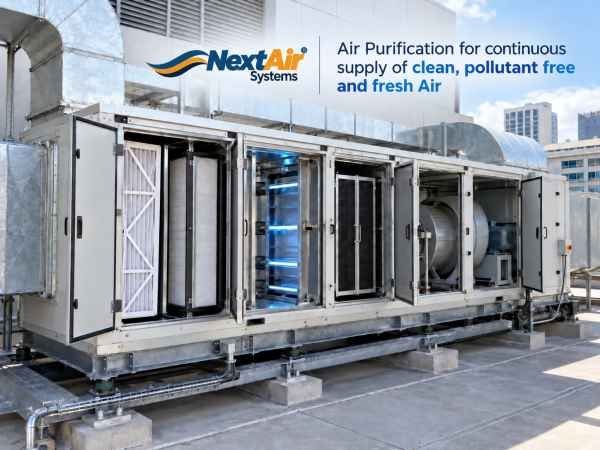
Why No Single Technology Covers Every Contaminant
This is the most important thing to understand before specifying any air purification system: HEPA filtration, UV-C irradiation, and activated carbon adsorption each address a different category of airborne contaminant, and none of them substitutes for the others.
HEPA filtration physically captures particles as air passes through a dense fiber matrix, removing 99.97% of particles down to 0.3 microns — genuinely effective against dust, allergens, mold spores, and particulate-borne pathogens, but it does nothing to gases, odors, or VOCs.
UV-C germicidal irradiation inactivates bacteria and viruses using germicidal ultraviolet light, addressing biological contamination that filtration alone won’t stop — particularly effective for coil and surface disinfection inside the AHU itself, reducing microbial growth that would otherwise recirculate through the system. UV-C has limited effectiveness against fast-moving airborne contaminants unless properly dosed for actual air velocity, and it does nothing for particulates or gases.
Activated carbon adsorption absorbs VOCs, fumes, and odors that neither HEPA nor UV-C touch — the same dry adsorption technology covered in our dry odor control adsorbers guide and dry VOC adsorbers guide.
A truly complete centralized system layers these technologies together, matched to the actual contaminants relevant to your facility — not a single technology marketed as a universal solution.
Understanding Filtration Grades: MERV, HEPA, and What the Numbers Actually Mean
One of the most common specification mistakes is treating “filtration” as a single decision rather than a graded scale, where the correct answer depends entirely on your actual contaminant profile and application:
| Grade | Capture efficiency | Smallest particle size | Typical application |
|---|---|---|---|
| MERV 8 | Captures larger particles (dust, pollen) | ~3-10 microns | General commercial HVAC |
| MERV 13-14 | Captures most fine particulates | ~0.3-1 microns | General indoor air quality improvement (current baseline recommendation) |
| ISO 16890 (ePM1/ePM2.5/ePM10) | Rated directly against PM1/PM2.5/PM10 fractions | Varies by rating | International specs referencing health-relevant particle sizes |
| HEPA | 99.97% at the hardest-to-catch size | 0.3 microns | Cleanroom, healthcare, biological containment |
| ULPA | 99.999%+ | 0.12 microns | Semiconductor-adjacent, most demanding cleanrooms |
MERV (Minimum Efficiency Reporting Value) ratings run from 1 to 16 under the ASHRAE 52.2 standard, measuring a filter’s ability to capture particles across three size ranges. MERV 8 filters, common in general commercial HVAC, capture larger particles like dust and pollen but pass through most fine particulates. MERV 13, increasingly the baseline recommendation for general indoor air quality improvement, captures a meaningfully higher fraction of fine particulate matter including many bacteria-sized particles.
ISO 16890, the newer international standard, classifies filters by their actual capture efficiency against PM1, PM2.5, and PM10 particle size fractions — a more directly health-relevant classification than MERV’s older test method, and increasingly the reference standard for international specifications.
HEPA (High-Efficiency Particulate Air) filtration sits above both scales, defined specifically as removing 99.97% of particles at the 0.3-micron most-penetrating particle size — the size range that’s hardest for any filter media to capture, since larger particles get caught by impaction and smaller particles get caught by diffusion, while particles right around 0.3 microns fall into the gap between those two capture mechanisms.
ULPA (Ultra-Low Penetration Air) filtration exceeds HEPA, capturing 99.999% or more at 0.12 microns, reserved for the most demanding cleanroom and semiconductor-adjacent applications where even HEPA-grade filtration isn’t sufficient.
The buying mistake to avoid in both directions: specifying HEPA or ULPA filtration for general commercial ventilation adds substantial cost and pressure drop (meaning higher fan energy consumption) with little practical air quality benefit over MERV 13-14 for that application, while specifying only MERV-rated general filtration for a cleanroom, pharmaceutical, or biological containment application leaves a facility meaningfully underprotected against the specific particle sizes that actually matter for that use case.
Correct UV-C Sizing Is a Real Engineering Problem
UV-C effectiveness depends on dose, not just lamp output: inactivation is a function of UV intensity multiplied by exposure time, expressed as fluence (mJ/cm²), and each pathogen has a different dose required for meaningful inactivation — some bacteria and viruses inactivate at relatively low fluence, while others, particularly certain fungal spores, require substantially higher dose for the same log-reduction target. A UV-C system sized against a generic assumption rather than the specific organisms relevant to your facility risks under-dosing exactly the contaminants that matter most.
Two failure modes are common and largely invisible without proper monitoring:
Lamp degradation. UV-C mercury lamps lose germicidal output over time — typically 15–20% by 8,000 hours of operation. A lamp reading “on” may be delivering a fraction of its rated dose, and without lamp-hour tracking tied to a replacement schedule, this degradation goes entirely unnoticed by facility staff.
Shadowing. Organisms in the wake of duct components, coil fins, or other equipment receive effectively zero UV dose regardless of lamp output, since UV-C requires direct line-of-sight exposure — meaning lamp placement and duct geometry are genuine engineering considerations, not an afterthought to be resolved after installation.
A HEPA filter loaded past its bypass point, or a UV-C lamp running at a fraction of rated output, is arguably worse than no system at all — it creates false assurance of protection that isn’t actually being delivered. Structured maintenance and lamp-hour tracking are not optional extras; they’re what makes the system’s stated performance real rather than nominal.
Emerging Technologies: What to Evaluate Carefully
Beyond the three established technologies above, the market includes newer approaches worth understanding — with appropriate caution about claims that outpace independent verification:
Photocatalytic oxidation (PCO) uses UV light combined with a catalyst, typically titanium dioxide, to break down organic contaminants at the catalyst surface. This can address some gas-phase compounds that activated carbon alone doesn’t fully capture, but PCO performance varies substantially by product design, and incomplete reactions can in some cases generate byproducts (including trace ozone or aldehydes) rather than fully breaking contaminants down to carbon dioxide and water — a genuine consideration worth confirming with independent third-party testing data specific to the product under evaluation, not just manufacturer claims.
Bipolar ionization generates charged ions intended to cause airborne particles to cluster together (improving filter capture) and to inactivate certain pathogens. Independent bodies including ASHRAE have noted that real-world efficacy data for many commercial ionization products is more limited than marketing claims often suggest, and some ionization technologies have been associated with measurable ozone generation as a byproduct — a facility evaluating this technology should specifically request independent, third-party (not manufacturer-funded) efficacy and ozone-emission test data before specifying it as a primary air quality strategy, rather than treating it as an established equivalent to HEPA or UV-C.
The practical buying guidance here: established technologies (HEPA, properly-dosed UV-C, activated carbon) should form the core of any specification, with emerging technologies considered only as a really evaluated supplement, backed by independent data specific to the product being purchased.
Where Centralized Air Purification Matters Most
Healthcare and life sciences. Cleanroom standards and biological hazard control depend on HEPA and UV-C working together, particularly relevant in pharmaceutical and laboratory environments already covered by our pharmaceutical humidity control guide.
Manufacturing facilities. Dust, fumes, and particulate matter affect both worker health and equipment performance — activated carbon and media filtration address VOCs and particulates that would otherwise accumulate in the space and on equipment.
Commercial and institutional buildings. Offices, educational institutions, and high-occupancy spaces benefit from combined filtration and UV-C for occupant comfort, allergen reduction, and pathogen risk reduction, particularly in dense or poorly ventilated spaces.
Data centers and precision environments. Particulate control matters here for equipment protection as much as occupant health, since fine dust accumulation on sensitive electronics and cooling equipment can degrade performance and reliability over time, independent of any human-health consideration.
New Construction Versus Retrofit: A Notably Different Specification Problem
Whether a centralized air purification system is going into a new building or being added to an existing one changes the specification conversation substantially, and it’s worth confirming which situation applies before evaluating equipment:
New construction allows filtration, UV-C, and adsorption stages to be designed into the AHU and duct system from the outset, with fan capacity, static pressure budget, and duct geometry all sized around the final filtration and purification stack from day one.
Retrofit into an existing system requires confirming that the existing fan can handle the added static pressure drop from higher-MERV filtration or additional filter stages without a capacity shortfall, that there’s physical space in the AHU or duct run for UV-C lamp placement with adequate line-of-sight coverage, and that controls integration (interlocks, monitoring, alarms) can actually connect to the building’s existing building management system. A retrofit that skips this assessment and simply swaps in higher-grade filters without confirming fan capacity is a common, avoidable way to end up with reduced airflow and an underperforming system rather than the intended air quality improvement.
Total Cost of Ownership: What Buyers Often Miss
The purchase price of filtration media, UV-C lamps, and carbon adsorption units is only part of the real cost of operating a centralized system, and a buyer comparing options purely on upfront equipment cost is very likely to end up choosing wrong:
Filter replacement cadence and cost scales with MERV rating and facility particulate load — higher-efficiency filters generally cost more per unit and may need more frequent replacement in high-particulate environments, a genuine recurring line item that should be budgeted alongside the initial system cost.
UV-C lamp replacement, given the 15-20% output degradation by roughly 8,000 hours of operation discussed above, is a scheduled recurring cost, not an occasional one — lamps in continuous-duty applications need replacement on a defined interval regardless of whether they’ve visibly failed, since visibly-working lamps can still be delivering inadequate dose.
Fan energy cost from added static pressure, since every filtration and purification stage adds resistance to airflow, meaning the building’s fans work harder and consume more energy to move the same air volume — higher-MERV filtration in particular carries a real, ongoing energy cost that should factor into any comparison between filtration grades, not just the filter media price itself.
Monitoring and controls integration, since lamp-hour tracking, filter pressure-drop monitoring, and alarm integration require either building management system capability or a dedicated monitoring solution — treating this as a genuine line item rather than an assumed free inclusion avoids an unpleasant surprise after installation.
Specification Checklist
- Identify your actual contaminant profile — particulates, biological, gaseous/VOC, or some combination — before choosing technologies, rather than defaulting to a single marketed solution.
- Match filtration grade to actual application, using MERV 13-14 for general indoor air quality improvement and reserving HEPA/ULPA for cleanroom, healthcare, or biological containment applications where the added cost and pressure drop are distinctly justified.
- Size UV-C by dose, not lamp count — confirm fluence calculations account for actual airflow velocity, duct geometry, and the specific target organisms relevant to your facility, not nominal lamp output.
- Build in maintenance visibility — lamp-hour tracking, filter pressure-drop monitoring, and scheduled replacement, since degraded performance in either HEPA or UV-C is invisible without structured monitoring.
- Add activated carbon capacity wherever VOCs or odor are part of the contaminant profile — neither HEPA nor UV-C addresses gas-phase contaminants at all.
- Confirm fan capacity and static pressure budget before specifying higher-grade filtration into an existing system, particularly for retrofit projects where the original AHU wasn’t designed around the final filtration stack.
- Request independent efficacy data for any emerging technology (PCO, bipolar ionization) under consideration, rather than relying solely on manufacturer performance claims.
- Budget total cost of ownership, including filter replacement cadence, UV-C lamp replacement schedule, and the ongoing fan energy cost of added static pressure — not just initial equipment price.
Specify the Right Centralized Air Purification System
Whether you need particulate control, pathogen inactivation, VOC/odor removal, or a properly layered combination, NextAir Systems can help you specify a system built for your actual contaminant profile and total cost of ownership. Contact us / Request a quote for a facility-specific recommendation.
Frequently Asked Questions
Do I need both HEPA and UV-C, or just one?
Generally both, if your facility has both particulate and biological contamination concerns — HEPA captures particles physically while UV-C inactivates organisms, and neither technology substitutes for the other.
Why would a HEPA filter or UV-C lamp fail without anyone noticing?
Because degradation is largely invisible without structured monitoring — a HEPA filter loaded past its bypass point still looks installed and functioning, and a UV-C lamp at reduced output still glows, but neither is delivering its rated performance without lamp-hour tracking and pressure-drop monitoring in place.
Does air purification handle odors and VOCs too?
Not with HEPA or UV-C alone — gas-phase contaminants like VOCs and odor compounds require activated carbon adsorption, a separate technology layer from particulate filtration and pathogen inactivation.
What's the difference between MERV 13 filtration and HEPA filtration?
MERV 13 captures a meaningfully higher fraction of fine particulates than general commercial filtration but doesn't reach HEPA's 99.97% capture rate at the hardest-to-catch 0.3-micron particle size — MERV 13-14 is generally adequate for general indoor air quality improvement, while HEPA is reserved for cleanroom, healthcare, and biological containment applications with a genuinely higher requirement.
Are bipolar ionization systems a reliable alternative to HEPA filtration?
Not as a substitute — independent bodies including ASHRAE have noted that real-world efficacy data for many commercial ionization products is more limited than marketing claims suggest, and some products have measurable ozone byproduct concerns, so this technology should be evaluated with independent, product-specific test data as a potential supplement, not relied on as a replacement for established filtration and UV-C technology.
Can an existing HVAC system be retrofitted with centralized air purification, or does it require new construction?
Retrofit is common and often practical, but requires confirming the existing fan can handle the added static pressure from higher-grade filtration, that there's adequate physical space and UV-C line-of-sight coverage in the existing duct run, and that controls can integrate with the building's existing management system — skipping this assessment is a common way retrofit projects underperform.
Talk to Our Engineering Team
Call +91-9311805618 or use our contact form for a facility-specific recommendation.
Contact Us