
Industrial Air Washers: Evaporative Cooling, Dust Removal & Humidification
An air washer solves a genuinely different problem than a desiccant dehumidifier — instead of removing moisture, it uses water to cool, clean, and humidify air, all through the same evaporative process. For hot, dry conditions and dusty industrial environments, that combination makes an air washer one of the most energy-efficient ways to condition large volumes of air. Understanding when an air washer is the right technology — and when it’s the wrong one — starts with understanding what it actually does, the psychrometrics that determine how well it performs in your specific climate, and what a truly complete specification needs to account for beyond just airflow capacity.
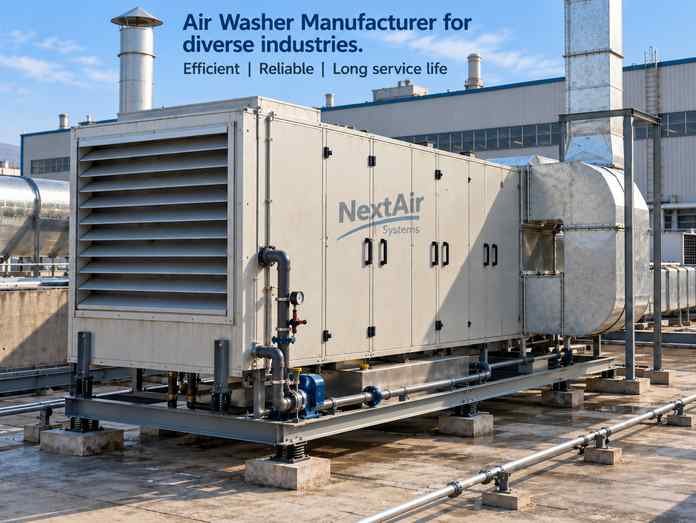
How an Air Washer Works
An air washer draws air through a chamber where it contacts a continuous supply of water — either through spray nozzles, rotating wetted discs, or saturated cellulose media — before passing through a droplet eliminator and out into the space or ductwork. Three things happen simultaneously:
Evaporative cooling. As water evaporates into the air stream, it absorbs heat, dropping the air temperature — the same physical principle behind a swamp cooler, scaled up to industrial capacity. This uses dramatically less energy than mechanical refrigeration, since there’s no compressor doing the work; the cooling comes from the latent heat of vaporization rather than a mechanical refrigeration cycle.
Particulate removal. Dust and airborne particulates passing through the wetted zone get trapped in the water rather than continuing downstream — a genuine air-cleaning effect, not just a side benefit.
Humidification. The same evaporation that cools the air also adds moisture to it, which is exactly what’s needed in hot, dry climates and processes where low humidity causes static, product defects, or material handling problems.
The Psychrometrics Behind Why Evaporative Cooling Works — and Where It Stops Working
The cooling an air washer delivers isn’t arbitrary — it’s governed by the difference between a location’s dry-bulb temperature (what a standard thermometer reads) and its wet-bulb temperature (the lowest temperature achievable through evaporation alone, given the air’s actual moisture content). This gap is called the wet-bulb depression, and it’s the single number that determines how much cooling an air washer can realistically deliver in a given location.
In hot, dry desert climates, the wet-bulb depression can be substantial — 15-20°F or more isn’t unusual — meaning an air washer can achieve meaningfully significant cooling. In hot, humid coastal climates, the air is already close to saturated, the wet-bulb depression shrinks toward zero, and evaporative cooling has very little temperature drop left to deliver, regardless of equipment size or water flow rate. This is the physical reason air washers are a strong fit for arid and semi-arid industrial markets and a poor fit for humid coastal ones — it isn’t a matter of equipment quality, it’s a hard physical limit set by the local psychrometric conditions. Any air washer specification should start from your location’s actual design wet-bulb temperature, not a generic assumption carried over from a different climate.
Where Air Washers Fit — and Where They Don’t
Air washers are the right technology for facilities that need cooling and humidity added, not removed, typically in hot, dry, dusty conditions:
- Textile mills, where low humidity causes yarn breakage and static, and where dust from fiber processing needs continuous removal from the plant air.
- Large warehouses and industrial floors in hot, dry climates, where evaporative cooling at industrial CFM scale is dramatically cheaper to run than refrigerant-based cooling.
- Food processing and general manufacturing environments needing both temperature control and airborne dust management in one system.
- Metalworking and foundry operations, where high process heat combines with dry ambient conditions to create genuine heat-stress risk for workers, and where evaporative cooling can deliver meaningful relief at a fraction of the cost of mechanically cooling the entire floor area.
- Printing and packaging facilities, where low humidity causes paper curl, static buildup, and registration problems — evaporative humidification addresses the moisture side of this directly.
Air washers are not the right technology when the actual problem is excess humidity — a facility in a humid coastal climate, or one needing to hold a low RH target for compliance or process reasons, needs desiccant dehumidification instead, which removes moisture rather than adding it. See our guide to desiccant vs refrigerant dehumidifiers for that comparison. Some facilities really need both technologies in different zones or different seasons — an air washer for hot, dry-season cooling and humidification, and a desiccant dehumidifier for humid-season moisture control.
Air Washers Versus Other Cooling Technologies
Choosing between cooling approaches comes down to your climate, your budget, and how much precision you actually need:
| Technology | Adds humidity? | Relative energy cost | Best fit |
|---|---|---|---|
| Air washer (direct evaporative) | Yes — by design | Low | Hot, dry/arid climates; combined cooling + dust removal |
| Mechanical refrigeration (AC/chillers) | No | High | Any climate; precise setpoint control required |
| Swamp cooler (small-scale direct evaporative) | Yes | Low | Single rooms/small spaces, not industrial-scale floors |
| Indirect evaporative cooling | No | Low-moderate | Dry climates where added humidity can’t be tolerated |
Versus mechanical refrigeration (standard AC/chillers). Mechanical cooling works regardless of ambient humidity and can hold a precise temperature setpoint, but at meaningfully higher energy cost and equipment complexity — compressors, refrigerant circuits, and condensing equipment that an air washer simply doesn’t need. For large-volume industrial spaces in truly dry climates, the energy cost difference over a facility’s operating life is often the deciding factor in favor of evaporative cooling.
Versus direct evaporative “swamp coolers.” A basic swamp cooler and an industrial air washer operate on the same physical principle, but at very different scale and control precision — swamp coolers are typically sized for single rooms or small spaces, while industrial air washers are engineered for large-volume plant floors, precise humidity targets, and integration with dust control and filtration in a single unit.
Versus indirect evaporative cooling. Indirect systems cool air without adding moisture to the supply air stream, using a heat exchanger to transfer the cooling effect from a separate evaporatively-cooled air stream. This is the right choice when a facility needs the energy savings of evaporative cooling but can’t tolerate added humidity in the conditioned space — a distinctly different design goal from a direct air washer, which is specifically valued for adding humidity as part of its function.
Air Washer Configurations
Single-stage air washers focus primarily on cooling and dust removal, suited to general industrial floor cooling applications.
Two-stage air washers offer more precise control over both humidity and air purity, appropriate where tighter tolerances matter.
Custom-built units are engineered for specific conditions — high-temperature environments, chemical-heavy operations, or unusual airflow requirements that a standard configuration doesn’t fit.
Typical industrial air washer capacity ranges from around 5,000 to 100,000+ CFM, with area coverage depending on ceiling height, air change requirements, and the specific cooling load involved.
Key Components
- Wetted media or spray nozzles — the actual water-contact zone, using rotating discs, saturated cellulose pads, or atomizing nozzles depending on configuration.
- Water reservoir and recirculation system — water is continuously recirculated rather than consumed outright, with only evaporated water needing replenishment, keeping overall water use relatively efficient for the cooling delivered.
- Droplet eliminators (demisters) — remove excess water droplets before air exits the unit, preventing carryover into ductwork or the conditioned space.
- Induced draft fan — draws air through the unit and delivers it to the space or duct system.
- Pre-filtration — mechanical filters at the intake stage, improving both evaporation efficiency and overall air quality by removing larger particulates before the wetted zone.
Water Treatment: The Consideration Buyers Often Underestimate
Because an air washer continuously recirculates standing water at temperatures well suited to microbial growth, water treatment isn’t an optional add-on — it’s a core part of correctly specifying and operating the system. Two considerations deserve particular attention:
Legionella risk management. Recirculating wetted-media evaporative equipment is a recognized category of system where Legionella bacteria can proliferate if water quality isn’t actively managed, since stagnant or poorly treated warm water in a wetted, aerosol-generating environment is exactly the condition this organism favors. A properly specified air washer includes a genuine water treatment program — biocide dosing, regular blowdown to prevent mineral and biological concentration, and a maintenance schedule that treats water quality as a safety-relevant system parameter, not an afterthought. This is a real operational responsibility that any facility evaluating an air washer purchase should factor into total cost of ownership and staffing requirements, not a theoretical risk to dismiss.
Scale and mineral buildup. Evaporation concentrates dissolved minerals in the recirculating water over time, which without adequate blowdown and, in hard-water regions, water softening or treatment, can scale wetted media and spray nozzles, degrading both cooling performance and dust-removal efficiency. Facilities in hard-water regions should factor water treatment equipment and consumables into the total system cost, not just the air washer unit price.
Signs Your Facility Likely Needs an Air Washer
- Ambient plant temperature regularly exceeds comfortable working conditions during hot months, and mechanical cooling for the full floor area isn’t economically justified by the space’s use.
- Low ambient humidity is causing measurable problems — static discharge, yarn or fiber breakage, product curl, or material handling issues tied specifically to dry air rather than temperature.
- Airborne dust from a manufacturing process needs ongoing removal, and a combined cooling-plus-dust-control system would replace two separate pieces of equipment with one.
- Your facility sits in a notably arid or semi-arid climate where the local wet-bulb depression supports meaningful evaporative cooling — the single most important qualifying factor before evaluating anything else.
Specification Checklist Before You Buy
- Get your location’s actual design wet-bulb temperature, not a general climate assumption — this single figure determines the ceiling on achievable cooling and should come from local weather data, not a generic regional estimate.
- Calculate required CFM against your actual floor area and desired air changes per hour, rather than sizing to a round number that happens to be available.
- Confirm your water source quality and hardness, since this determines what water treatment equipment needs to be budgeted alongside the air washer itself.
- Decide between direct and indirect evaporative cooling based on whether added humidity in the conditioned space is acceptable or a problem for your specific process.
- Budget for water treatment and maintenance as an ongoing operational cost, not a one-time equipment purchase — Legionella risk management, blowdown, and scale control are recurring responsibilities.
- Confirm dust and particulate load expectations if air cleaning is a primary goal, since heavier particulate loads may warrant enhanced pre-filtration ahead of the wetted zone.
Specify the Right Air Washer for Your Facility
Whether you need evaporative cooling, dust removal, humidification, or some combination of the three, NextAir Systems can recommend the right air washer configuration for your actual climate and process requirements. Contact us / Request a quote for a facility-specific recommendation.
Frequently Asked Questions
Does an air washer remove or add humidity?
An air washer adds humidity through evaporative cooling — it's the right technology for hot, dry conditions needing both cooling and added moisture, not for facilities needing to remove excess humidity, which requires desiccant dehumidification instead.
Can an air washer replace refrigerant-based cooling?
For hot, dry climates, an air washer can provide substantial cooling at a fraction of the energy cost of mechanical refrigeration, though the achievable temperature drop depends on ambient humidity — evaporative cooling is less effective as ambient humidity rises, which is why it suits dry climates specifically, and why the local wet-bulb depression should be confirmed before assuming an air washer can substitute for mechanical cooling.
Does an air washer need a lot of water?
Water is continuously recirculated rather than consumed outright — only the water that actually evaporates needs to be replenished, making overall consumption relatively modest for the cooling and humidification delivered, though water treatment consumables (biocide, softening where needed) are a separate, genuine ongoing cost.
Is Legionella a real concern with industrial air washers?
Yes, distinctly — any recirculating, wetted evaporative system is a recognized category where Legionella can proliferate without active water treatment, meaning biocide dosing, blowdown, and a structured maintenance schedule are core operational requirements, not optional extras, for any facility running this equipment.
What's the difference between direct and indirect evaporative cooling?
Direct evaporative cooling (a standard air washer) adds moisture to the air it's cooling, while indirect evaporative cooling uses a heat exchanger to deliver the cooling effect without adding humidity to the conditioned air stream — the right choice depends on whether your process or space can tolerate added humidity.
How do I know if my climate is dry enough for an air washer to work well?
Check your location's design wet-bulb depression — the gap between dry-bulb and wet-bulb temperature during your hottest design conditions — since a larger gap means more available evaporative cooling, while a small gap (typical of humid coastal climates) means an air washer will deliver little meaningful temperature reduction regardless of equipment size.
Talk to Our Engineering Team
Call +91-9311805618 or use our contact form for a facility-specific recommendation.
Contact Us