
Industrial Air Handling Units: Components, Configurations & Sizing
An air handling unit is the piece of equipment that actually moves and conditions the air in a building or industrial facility — everything else in an HVAC system (chillers, boilers, ductwork, controls) exists to support what happens inside the AHU. For facilities across the Middle East, Africa, and India, where outside air can arrive at 45°C and near-saturation humidity within the same week, the AHU’s filtration, cooling, and dehumidification stages are doing far more work than the same equipment would in a temperate climate.
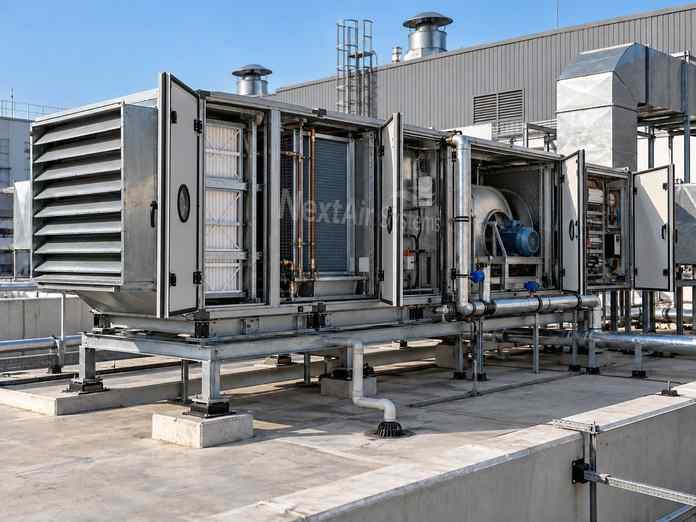
This guide covers what’s actually inside an air handling unit, how the major configurations differ, and what changes when you’re sizing one for extreme heat and humidity rather than a moderate climate.
What’s Inside an Air Handling Unit
A standard AHU is a large sheet-metal cabinet — typically ranging from around 2,000 to over 100,000 CFM — housing a sequence of components the air passes through in order:
Mixing section. Outside (fresh) air and return (recirculated) air combine here, with dampers controlling the ratio based on ventilation and energy requirements.
Filter section. Air passes through one or more filtration stages to remove particulates, dust, and other contaminants before reaching downstream components — filter grade depends on the application, from basic pre-filtration up to HEPA for cleanroom-grade requirements.
Cooling and heating coils. Chilled water, hot water, refrigerant, or steam coils condition the air to the target temperature. The cooling coil is also where sensible cooling and moisture condensation happen together in a conventional system — a distinction that matters enormously in humid climates, covered below.
Fan section. Centrifugal or plug fans move air through the unit and out into the connected ductwork, sized against the total static pressure of the filters, coils, and duct run.
Humidity control stage. Depending on climate and application, this may be a humidifier (for dry climates or processes needing added moisture) or dedicated dehumidification capacity (for facilities where the cooling coil alone can’t reach target RH without overcooling the space).
AHU vs. RTU vs. FCU: Which One You’re Actually Talking About
These terms get used loosely, but they’re distinctly different equipment classes:
| Equipment | Scale | Typical use | Installation |
|---|---|---|---|
| Air Handling Unit (AHU) | Large capacity, 2,000-100,000+ CFM | Multiple zones or entire building from a central plant | Built up from separate components on site |
| Rooftop Unit (RTU) | Small-to-mid, packaged | Retail, offices, mid-size commercial buildings | Single factory-built cabinet, simpler install |
| Fan Coil Unit (FCU) | Small, decentralized | Individual rooms or zones | Fed by chilled/hot water from a central plant |
- Air Handling Unit (AHU) — large-capacity equipment, typically built up from separate components, serving multiple zones or an entire building from a central plant.
- Rooftop Unit (RTU) — a packaged, all-in-one version combining heating, cooling, filtration, and airflow in a single factory-built cabinet, common in retail, offices, and mid-size commercial buildings where simpler installation matters more than large-scale capacity.
- Fan Coil Unit (FCU) — small, decentralized units serving individual rooms or zones, typically fed by chilled/hot water from a central plant rather than conditioning air independently.
For large industrial facilities, warehouses, and multi-zone commercial buildings across our region, a central AHU is generally the right scale of equipment — RTUs and FCUs solve a different problem.
Why Standard AHU Cooling Coils Struggle in Gulf and Monsoon Climates
A conventional AHU removes moisture as a byproduct of cooling: air passes over a chilled coil, drops below its dew point, and condenses out excess water. This works fine in moderate climates. It becomes a genuine engineering problem in two conditions common across our markets:
Extreme coastal dew points. Gulf coastal cities regularly see dew points in the high 20s°C during summer. Reaching a comfortable indoor RH through cooling-coil condensation alone means overcooling the space well below the temperature occupants or processes actually need, then reheating it back up — a genuinely wasteful way to control humidity.
Monsoon humidity spikes. In India, ambient RH can exceed 90% for extended periods. A cooling-coil-only AHU sized for average conditions will consistently fail to hold target humidity during exactly the months it matters most.
This is why AHUs serving these climates are frequently specified with a dedicated desiccant dehumidification stage — either integrated into the AHU or as a companion unit — rather than relying on the cooling coil alone. See our guide to desiccant vs refrigerant dehumidifiers for the underlying technology comparison.
Static Pressure and Fan Sizing: The Detail That Gets Underspecified
Every component an AHU pushes air through — filters, coils, dampers, ductwork — adds resistance, measured as static pressure. A fan sized against the coil and filter resistance alone, without accounting for the full duct run and any downstream equipment (terminal boxes, diffusers, additional filtration), will move less air than designed once the complete system is installed. This shows up later as a facility that can’t hit its target airflow or humidity despite the AHU itself being correctly specified — the fan simply can’t overcome the actual total static pressure it’s fighting.
Filter loading compounds this over time: a clean filter has meaningfully lower resistance than one approaching its replacement point, meaning a system designed with zero margin for filter loading will lose airflow capacity as filters age between service intervals, not just at the moment of specification. Building in a reasonable static pressure margin — and reviewing it against actual filter-loading data rather than only the clean-filter rating — avoids a system that performs correctly on day one and underperforms by month three.
Energy Recovery: Where It Helps and Where It Doesn’t
Heat and enthalpy wheels, and plate-type heat exchangers, transfer energy between the outgoing exhaust air stream and the incoming outside air stream before either reaches the AHU’s main coils — meaning the coils have less work to do, since incoming air arrives partially pre-conditioned by energy that would otherwise be exhausted and wasted.
This is most valuable where outside air conditions are extreme and ventilation rates are high — exactly the profile common across Gulf, African, and Indian climates, where incoming air can be both very hot and very humid relative to the space being conditioned. An enthalpy wheel captures both sensible heat and moisture from the exhaust stream, making it the more relevant choice than a sensible-only plate exchanger in humid climates specifically, since latent load (moisture) is often the larger share of the total cooling burden in these conditions, not just dry-bulb temperature.
The tradeoff worth confirming before specifying: energy recovery equipment adds its own static pressure and maintenance requirement (wheel cleaning, seal inspection), so the energy savings need to be weighed against that added complexity for smaller systems — the case for energy recovery grows stronger as ventilation rates and the outside-to-inside condition gap both increase, and is most clearly justified in high-ventilation-rate applications like hospitals, laboratories, and industrial process areas rather than low-ventilation general office space.
Key Specification Decisions
- Total airflow (CFM/CMH) against the served zone’s volume, occupancy, and process requirements — not a rule-of-thumb per square meter.
- Filtration grade matched to the application: general ventilation, ESD-sensitive electronics, or pharmaceutical cleanroom classifications each require a different filter train.
- Cooling/heating coil capacity sized against your region’s actual peak wet-bulb conditions, not the annual average.
- Dehumidification strategy — cooling-coil-only, or a dedicated desiccant stage — based on how far your target RH sits below what condensation-based cooling alone can reliably achieve.
- Energy recovery — heat/enthalpy wheels or plate exchangers between exhaust and intake air streams, particularly valuable where outside air conditions are extreme and ventilation rates are high.
- Static pressure budget, calculated against the complete system — filters, coils, ductwork, and terminal equipment — with margin for filter loading over the service interval, not just the clean-filter rating.
- Retrofit versus new construction, since adding dehumidification capacity or higher-grade filtration to an existing AHU requires confirming the existing fan can handle the added resistance before specifying new internal components.
Specify the Right Air Handling Unit for Your Climate
Whether you’re specifying a new AHU or adding dehumidification capacity to an existing system that can’t hold target humidity, NextAir Systems can help. Contact us / Request a quote for a facility-specific recommendation.
Frequently Asked Questions
What's the difference between an AHU and an RTU?
An AHU is typically a larger, built-up system serving multiple zones from a central plant, while an RTU packages heating, cooling, filtration, and airflow into one factory-built cabinet, usually for smaller commercial applications where simpler installation matters more than large-scale capacity.
Why does my AHU struggle to hit target humidity even though the temperature is fine?
Standard AHUs remove moisture only as a byproduct of cooling-coil condensation — in high-dew-point or monsoon climates, this often means the coil would need to overcool the space to reach target RH, which is why many facilities in these climates add dedicated desiccant dehumidification rather than relying on the cooling coil alone.
What filtration grade does my AHU need?
It depends entirely on the application — general ventilation needs far less than an ESD-controlled electronics floor or a pharmaceutical cleanroom, and specifying too little filtration is a common, costly mistake to correct after installation.
Does energy recovery make sense for every AHU?
Not necessarily — it's most clearly justified in high-ventilation-rate applications with a large gap between outside and inside conditions, like hospitals, laboratories, and industrial process areas; for smaller systems with modest ventilation rates, the added static pressure and maintenance burden may outweigh the energy savings.
Why would a correctly sized AHU still underperform after a few months?
Filter loading is a common cause — a system designed with zero static pressure margin for filter loading performs correctly with clean filters but loses airflow capacity as filters approach their replacement point, meaning the specification should account for aged-filter resistance, not just the clean-filter rating.
Can an existing AHU be retrofitted with dehumidification or higher-grade filtration?
Often yes, but only after confirming the existing fan can handle the added static pressure — retrofitting internal components without this check is a common way projects end up with reduced airflow rather than the intended improvement.
Talk to Our Engineering Team
Call +91-9311805618 or use our contact form for a facility-specific recommendation.
Contact Us