
Desiccant vs Refrigerant Dehumidifier: Which Is Right for Your Facility?
Choosing between a desiccant dehumidifier and a refrigerant dehumidifier is one of the first — and most consequential — decisions a facility manager, MEP consultant, or procurement team makes when specifying humidity control equipment. Get it right, and you protect millions of dollars in stored inventory, comply with GMP or ISO cleanroom standards, and cut years off your energy bill. Get it wrong, and you end up with a unit that frosts over in a cold store, can’t hold spec in a Gulf summer, or simply can’t reach the low relative humidity your process demands.
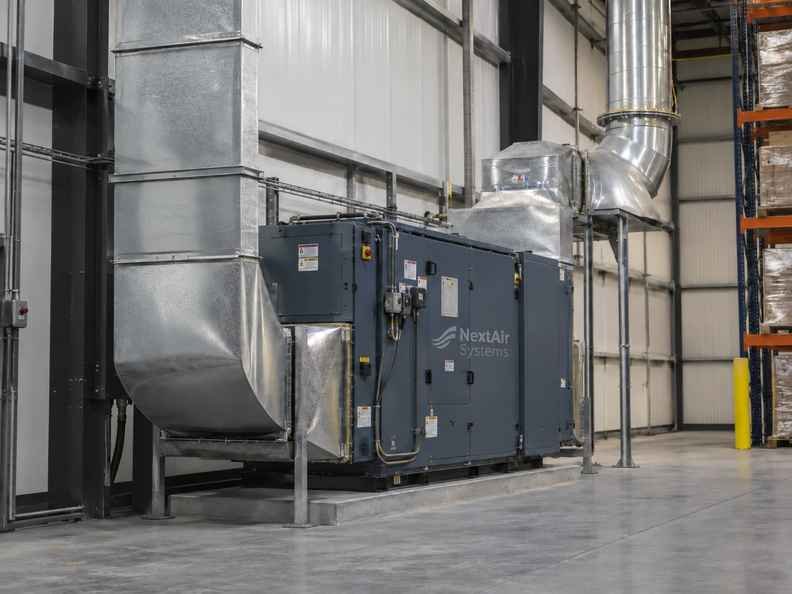
This guide breaks down exactly how a desiccant dehumidifier works compared to a refrigerant (condensation) dehumidifier, when each technology wins, and — because climate is the single biggest variable in this decision — why the hot, humid conditions found across the Middle East, Africa, and India change the calculation entirely.
What Is a Desiccant Dehumidifier?
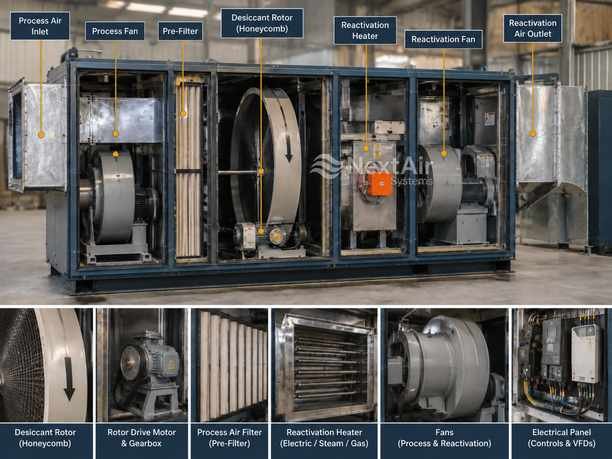
A desiccant dehumidifier removes moisture from the air through adsorption rather than condensation. At the heart of every desiccant dehumidifier is a slowly rotating desiccant rotor (also called a desiccant wheel), typically impregnated with silica gel or a molecular sieve material with an enormous internal surface area engineered to attract and hold water vapor.
Here’s the working principle, step by step:
- Process air (the humid air from your facility) is drawn through one segment of the rotating desiccant wheel. As it passes through, the desiccant material adsorbs moisture directly from the airstream — no cooling is involved.
- The now-dry air is discharged back into the space, typically 3–5°C warmer than it entered, because adsorption is an exothermic process.
- As the wheel rotates, the moisture-laden section moves into a separate reactivation segment, where a heater (electric or steam) drives hot air through the desiccant to strip out the collected moisture and exhaust it outside the building.
- The now-dry section of the wheel rotates back into the process airstream, and the cycle repeats continuously.
Because a desiccant dehumidifier doesn’t rely on cooling a coil below the air’s dew point, it can achieve extremely low relative humidity — down to 1–2% RH in engineered dry-room applications — and it performs just as effectively at low ambient temperatures as it does at high ones. This is the single most important technical distinction between a desiccant dehumidifier and its refrigerant counterpart, and it’s why desiccant technology dominates in cold storage, cleanrooms, and low-dew-point industrial processes.
What Is a Refrigerant (Condensation) Dehumidifier?
A refrigerant dehumidifier — sometimes called a condensation or compressor dehumidifier — works on the same principle as an air conditioner. A fan pulls humid air across a refrigerated coil that’s colder than the air’s dew point. Water vapor condenses on the coil surface, drips into a collection tray or drain line, and the now-drier (and now-cooler) air passes across a warm condenser coil before being released back into the room.
Refrigerant dehumidifiers are mechanically simpler than desiccant systems, generally have a lower upfront cost, and are highly effective in warm, humid environments — think a 28–35°C warehouse in a coastal city. But the physics work against them once temperatures drop. Below roughly 15–18°C, the coil surface temperature can fall below freezing before it reaches the air’s dew point, causing frost to build up on the coil. Left unmanaged, this frost blocks airflow entirely, which is why refrigerant units need auto-defrost cycles that reduce their effective moisture-removal capacity in cooler spaces.
Desiccant vs Refrigerant Dehumidifier: The Core Technical Differences
The decision between a desiccant dehumidifier and a refrigerant dehumidifier ultimately comes down to five variables: ambient temperature range, target relative humidity, dew point requirement, energy profile, and application type.
| Factor | Desiccant Dehumidifier | Refrigerant Dehumidifier |
|---|---|---|
| Operating principle | Adsorption onto a silica gel/molecular sieve rotor | Condensation on a chilled coil |
| Effective temperature range | Sub-zero to ~50°C ambient — largely unaffected by temperature | Best above 15–18°C; loses capacity and risks coil frost below this |
| Achievable relative humidity | As low as 1–2% RH in engineered systems | Practical floor around 35–45% RH |
| Dew point capability | Very low dew points achievable, ideal for cold and dry-room applications | Limited by coil temperature; not suited to sub-freezing dew points |
| Air discharge | Slightly warmer (adds 3–5°C) | Cooler, since it’s a cooling-based process |
| Best-fit environments | Cold stores, cleanrooms, pharma, electronics, dry rooms, low-temperature process areas | Warm general warehouses, commercial spaces, indoor pools, moderate-humidity storage |
| Energy behavior | Reactivation heater is the main energy draw; efficient at low-humidity targets | Compressor-driven; efficient at moderate targets in warm air, less so at temperature extremes |
| Maintenance profile | Rotor and reactivation heater servicing; fewer moving parts prone to icing | Coil cleaning, refrigerant circuit maintenance, defrost system upkeep |
Neither technology is universally “better” — a desiccant vs refrigerant dehumidifier decision is really a climate-and-application decision, not a quality decision. A refrigerant dehumidifier in a 32°C, 70% RH warehouse can be extremely cost-effective. That same unit dropped into a 5°C cold store chasing 35% RH will struggle and ice up. Flip the environments, and a desiccant dehumidifier — while capable everywhere — may be more capital-intensive than the application actually requires.
Why Climate Changes the Desiccant vs Refrigerant Dehumidifier Calculation
This is where the decision gets genuinely regional, and it’s why a desiccant dehumidifier so often wins in the Gulf, across Africa, and in India specifically.
Middle East (UAE, Saudi Arabia, Qatar, Oman, Kuwait, Bahrain): Inland cities like Riyadh see low ambient humidity for much of the year, but coastal cities — Dubai, Abu Dhabi, Jeddah, Dammam, Doha, Muscat — experience some of the highest dew points on the planet during summer months, driven by evaporation off the Arabian Gulf and Red Sea. Combine that with heavily air-conditioned buildings, and you get a classic recipe for condensation on cold surfaces, corrosion in storage areas, and mold in poorly managed warehouses. A desiccant dehumidifier sized correctly for Gulf dew points can hold a stable low relative humidity through the peak summer moisture load in a way a refrigerant-only system often cannot.
Africa (Nigeria, Kenya, South Africa, Egypt, Ghana, Tanzania): Coastal West and East African cities — Lagos, Mombasa, Dar es Salaam — carry persistent high humidity year-round, while inland and southern regions (Johannesburg, much of the South African interior) run cooler and drier, closer to conditions where refrigerant technology performs well on its own. This split makes climate-appropriate technology selection — rather than a one-size-fits-all dehumidifier — the deciding factor for African facility managers.
India: Monsoon conditions push ambient relative humidity above 90% across Mumbai, Chennai, and Kolkata for extended periods each year, and Indian pharmaceutical, food, and electronics manufacturers must hold tight humidity specifications through it. A desiccant dehumidifier engineered for Indian monsoon loads is frequently the only technology that keeps cleanrooms and dry rooms within spec during peak monsoon months, regardless of how high outdoor dew points climb.
In all three regions, the practical guidance is the same: the hotter and more humid your ambient climate, and the lower your target relative humidity, the more the case shifts toward a desiccant dehumidifier over a refrigerant unit — particularly for any application with a compliance-driven humidity ceiling.
Industry-by-Industry: When to Choose a Desiccant Dehumidifier
Pharmaceutical manufacturing and storage. GMP guidelines typically require production and storage areas to sit within a 30–60% RH band, with tighter tolerances in cleanrooms and for hygroscopic active pharmaceutical ingredients. A desiccant dehumidifier is the standard choice here because it holds precise low humidity regardless of ambient conditions outside — critical when a facility in Riyadh or Mumbai can’t let outdoor monsoon or Gulf humidity dictate indoor compliance.
Electronics manufacturing. Maintaining 40–60% RH is the widely cited safe zone for preventing electrostatic discharge (ESD) during PCB assembly and soldering, referenced in standards like IPC/JEDEC J-STD-033 for moisture-sensitive device handling. A desiccant dehumidifier’s stability at low humidity — independent of coil-icing risk — makes it the natural fit for cleanroom and ESD-controlled zones.
Cold storage and food storage facilities. Cold rooms are the clearest case where a refrigerant dehumidifier is the wrong tool: below the coil-icing threshold, condensation and frost buildup on floors, walls, and product become a genuine safety and quality risk. A desiccant dehumidifier removes moisture before air ever reaches the cold zone, protecting packaging integrity and eliminating the ice-buildup problem entirely.
Warehouses and logistics. General ambient warehouses in warm coastal cities can often be served effectively by refrigerant dehumidifiers. But warehouses storing moisture-sensitive goods — electronics, pharmaceuticals, textiles, paper — or operating in regions with extreme dew points (coastal Gulf, coastal West Africa) increasingly specify desiccant systems to guarantee a stable low RH year-round.
Aerospace manufacturing. Composite curing, adhesive bonding, and avionics assembly typically require 40–60% RH with tight tolerances, and dry-room technology for advanced composite work can call for humidity as low as 1% RH — achievable only with desiccant dehumidification.
Chemical processing. Hygroscopic powders, fluid-bed drying, and silo storage all demand ultra-low, stable humidity that a desiccant dehumidifier delivers regardless of the temperature of the process area.
Textile manufacturing. Textile processes actually span a wide humidity range depending on the stage (carding, spinning, weaving), and many textile facilities use humidification rather than dehumidification — but storage and warehousing of finished goods, particularly in humid coastal regions, still benefits from desiccant-based moisture control to prevent fiber damage and static issues.
Commercial buildings and spaces. Offices, hotels, data centers, and indoor pools generally target a more moderate 40–60% RH comfort band. Here, the decision often comes down to ambient temperature: warm commercial spaces in coastal Gulf or African cities frequently pair refrigerant systems with supplementary desiccant dehumidification during peak humidity months, rather than relying on one technology alone.
Energy Efficiency and Total Cost of Ownership
A common misconception is that a desiccant dehumidifier is always more expensive to run than a refrigerant dehumidifier. The reality depends entirely on the target humidity and the ambient conditions:
- At moderate humidity targets in warm climates, refrigerant dehumidifiers are typically the more energy-efficient choice — the compressor-driven condensation process is well-matched to those conditions.
- At low humidity targets, low temperatures, or high ambient dew points, a refrigerant dehumidifier’s efficiency collapses (or the unit simply can’t reach spec), while a desiccant dehumidifier’s reactivation-heater energy draw stays comparatively predictable. In cold storage specifically, avoiding condensation and ice buildup with desiccant dehumidification can meaningfully reduce the cooling load and defrost-heater energy a facility would otherwise spend fighting moisture — some cold-storage operators report double-digit percentage energy savings once desiccant dehumidification is added upstream of the refrigeration system.
- Total cost of ownership should always include reactivation or compressor energy, maintenance (coil cleaning and refrigerant handling for refrigerant units; rotor and heater servicing for desiccant units), and the cost of failing to hold spec — spoiled inventory, failed compliance audits, or corroded equipment often dwarf the energy-cost difference between the two technologies.
A Practical Framework for the Desiccant vs Refrigerant Dehumidifier Decision
Before specifying a desiccant dehumidifier or a refrigerant unit, walk through these questions:
- What is your target relative humidity? Below ~45% RH, desiccant technology becomes the more reliable choice.
- What is your ambient (or process area) temperature? Below ~15–18°C, refrigerant dehumidifiers lose efficiency and risk icing; desiccant systems remain stable.
- Do you have a regulatory or compliance driver? GMP, ISO cleanroom, HACCP, or ESD standards with tight RH bands almost always point toward desiccant dehumidification.
- What’s your local climate and dew point profile? Coastal Gulf, coastal African, and Indian monsoon conditions push the calculation toward desiccant technology, especially for any application with a low target RH.
- Is this a cold storage or sub-ambient application? If yes, desiccant dehumidification upstream of refrigeration is the industry-standard approach.
- What’s your available capital vs. operating budget? Refrigerant units generally cost less upfront; desiccant systems often cost less to operate reliably once you factor in avoided spoilage, defrost energy, and compliance risk.
Choosing the Right Dehumidification Technology for Your Facility
The desiccant vs refrigerant dehumidifier decision isn’t about picking the “premium” option — it’s about matching the technology to your target humidity, your ambient climate, and your compliance requirements. Across the Middle East, Africa, and India, where high dew points, coastal humidity, and monsoon conditions are the norm rather than the exception, a properly sized desiccant dehumidifier is very often the technology that keeps pharmaceutical cleanrooms, electronics manufacturing floors, cold storage facilities, and moisture-sensitive warehouses within spec year-round — while a refrigerant dehumidifier remains a strong, cost-effective choice for warmer, moderate-humidity commercial and general storage applications.
If you’re not sure which technology — or which capacity — fits your facility, the right next step is a proper humidity and dew point assessment of your space, factoring in local climate data, target RH, and application requirements, before specifying equipment.
Browse Dehumidifiers by Industry or Location
See how desiccant dehumidification applies to your specific industry, or find equipment guidance for your region: all industries and all locations.
- Aerospace Dehumidifier Guide: Composite Curing, Dry Rooms & Avionics Humidity Control
- Chemical Industry Dehumidifiers: Resin Drying & Hygroscopic Material Handling
- Cold Storage Dehumidifiers: Frost Prevention & Refrigeration Efficiency
- Commercial Building Dehumidifiers: Pools, Archives & Data Center Humidity Control
- Electronics Manufacturing Dehumidifiers: ESD Control & Moisture-Sensitive Device Protection
- Factory Dehumidifiers: Welding Quality, Mold Prevention & Condensation Control
- Industrial Dehumidifiers in Bahrain
- Industrial Dehumidifiers in Bengaluru
- Industrial Dehumidifiers in Chennai
- Industrial Dehumidifiers in Delhi NCR
- Industrial Dehumidifiers in Dubai
- Industrial Dehumidifiers in Egypt
Frequently Asked Questions
Is a desiccant dehumidifier better than a refrigerant dehumidifier?
Neither is universally better — it depends on your target humidity, ambient temperature, and application. A desiccant dehumidifier is generally the better choice for low-humidity targets, cold environments, and compliance-driven applications (pharma, electronics, cold storage). A refrigerant dehumidifier is often more cost-effective for moderate-humidity targets in warm, general-purpose spaces.
Can a desiccant dehumidifier work in hot Gulf, African, or Indian climates?
Yes — in fact, a desiccant dehumidifier is frequently the preferred technology in these climates precisely because it performs consistently regardless of ambient temperature, holding a stable low relative humidity through Gulf summer humidity, coastal African conditions, and Indian monsoon peaks.
Why does my refrigerant dehumidifier ice up?
Coil icing occurs when the refrigerant coil's surface temperature drops below freezing before the surrounding air reaches its dew point — typically in spaces below 15–18°C. This is the primary reason refrigerant dehumidifiers aren't recommended for cold storage or low-temperature process areas.
What relative humidity can a desiccant dehumidifier achieve?
Engineered desiccant dehumidification systems can achieve relative humidity as low as 1–2% RH, far below what refrigerant technology can practically reach.
Do desiccant dehumidifiers cost more to run than refrigerant units?
Not necessarily. At low humidity targets or low temperatures, a desiccant dehumidifier is typically more energy-efficient in practice than a refrigerant unit, because the refrigerant unit either cannot reach the target RH or must run constant defrost cycles that waste energy without removing moisture.
Talk to Our Engineering Team
Call +91-9311805618 or use our contact form for a facility-specific recommendation.
Contact Us