
Dry Odor Control Adsorbers: How They Work, Media Selection & System Design
A dry odor control adsorber does one specific job: it pulls odorous and hazardous gas molecules out of an air stream by binding them to the surface of a solid media, without using water, chemical spray, or any liquid at all. That’s the entire technical premise behind “dry” — no scrubbing liquid, no wastewater to manage, no bacterial growth to monitor in a recirculating sump. For facilities dealing with hydrogen sulfide (H₂S), mercaptans, ammonia, or VOCs, a properly engineered dry odor control adsorber can hit removal efficiencies above 99% while avoiding the water consumption and liquid waste stream that come with wet chemical scrubbing.
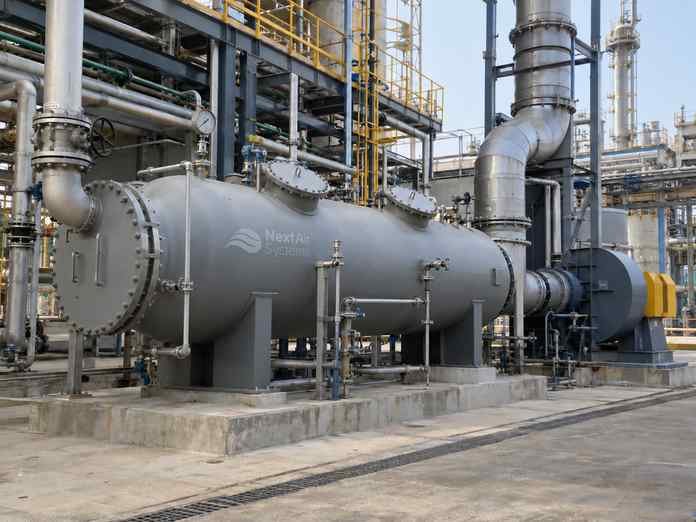
This guide covers exactly how adsorption works at the molecular level, how to select the right adsorbent media for your target compounds, the system configurations available, and how a dry odor control adsorber compares technically to a wet scrubber — information that matters directly to engineers specifying equipment for wastewater treatment plants, food processing facilities, and industrial exhaust streams across the Middle East, Africa, and India.
How Dry Adsorption Actually Works
Adsorption is the adhesion of gas-phase pollutant molecules to the surface of a porous solid as contaminated air passes through it — distinct from absorption, where a pollutant dissolves into a liquid. A dry odor control adsorber achieves this through one of two mechanisms:
Physical adsorption (physisorption). Van der Waals forces attract odor molecules into the vast internal pore network of a material like activated carbon, which typically offers 800–1,200 m² of surface area per gram. This is the dominant mechanism for VOCs, organic sulfur compounds, and aromatic hydrocarbons, and it’s reversible — at elevated temperature, adsorbed molecules desorb, which is the basis for thermal regeneration in some carbon systems.
Chemical adsorption (chemisorption). Impregnated carbons carry a chemical reagent on the carbon surface that reacts with the target compound, converting it into a non-volatile salt or oxide rather than just holding it physically. KOH-impregnated carbon, for example, converts hydrogen sulfide into potassium sulfide and potassium sulfate. This reaction is irreversible, which means the media has a genuine consumption rate and finite service life, but it also means chemisorption-based adsorbers can achieve very high removal efficiency for compounds that physical adsorption alone handles poorly.
Adsorbent Media Selection
Choosing the right media — and the right combination of media — is the single most consequential engineering decision in a dry odor control adsorber, because different odor compounds respond to different pore structures and chemistries:
| Pore type | Size | What it adsorbs |
|---|---|---|
| Micropores | Under 2 nm | Small molecules — H₂S, ammonia |
| Mesopores | 2–50 nm | Larger VOCs, mercaptans |
| Macropores | Over 50 nm | Transport channels — move gas molecules to interior adsorption sites rather than adsorbing directly |
A well-designed odor control adsorber needs all three pore types working together, which is why coal-based activated carbon — with its naturally broad pore-size distribution — is the most common base media for multi-compound industrial odor applications. From there, media is often further specialized: carbon impregnated to target hydrogen sulfide specifically, a different impregnation grade for mercaptans, and in some cases a secondary polishing media stage for compounds the primary bed doesn’t fully capture. Zeolites and synthetic polymer adsorbents are used in specific applications where their particular pore geometry or chemical selectivity outperforms carbon.
System Configurations
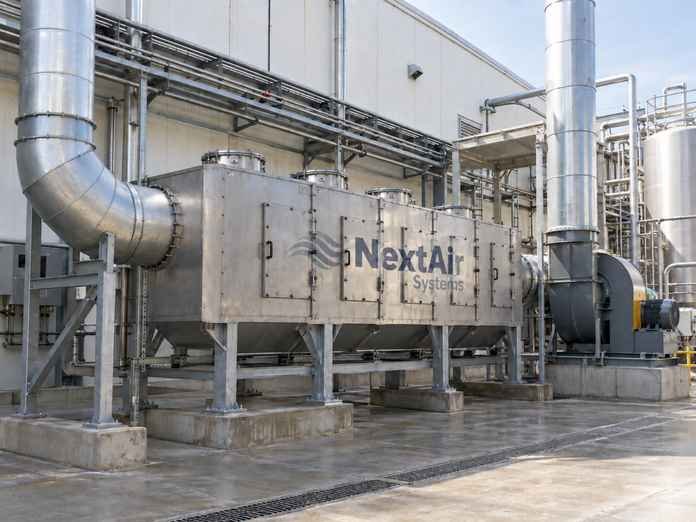
A dry odor control adsorber is engineered around vessel geometry as much as media selection:
- Deep bed adsorbers — horizontal or vertical configuration, with a single deep bed or multiple beds in series within the vessel, generally suited to higher-concentration or higher-flow applications.
- Radial flow adsorbers — gas flows radially through an annular bed rather than straight through a packed column, typically offering lower pressure drop for a given bed volume.
- Dual-bed vertical adsorbers — roughly double the flow-rate capacity of a single-bed unit in the same vessel diameter, and allow individual layers of media to be changed without disturbing the others, making them well suited to multi-media (“dual media”) configurations.
- Non-regenerative bulk-packed and filter-bed designs — the most common configuration for odor control specifically, where spent media is replaced rather than regenerated on-site, appropriate given how consumption-based chemisorption media already is.
Typical applications for smaller adsorbers range from roughly 50 to 4,000 CFM, with larger deep-bed and multi-stage systems scaling well beyond that for major industrial and municipal installations.
Dry Adsorbers vs. Wet Scrubbers: The Technical Comparison
| Factor | Dry Odor Control Adsorber | Wet Chemical Scrubber |
|---|---|---|
| Water consumption | None | Continuous — recirculating liquid requires ongoing water supply |
| Wastewater/effluent | None | Blowdown stream requires treatment and disposal |
| Footprint | Generally smaller | Generally larger (tower, sump, pumps, piping) |
| Maintenance | Media replacement on a defined schedule | Ongoing monitoring for bacterial/fungal growth, pump and nozzle maintenance, chemical dosing |
| Energy use | Lower — blower only | Higher — pumps plus blower |
| Removal efficiency | Very high (>99%) for well-matched media and compound | Very high, and often preferred for extremely high-concentration or highly water-soluble streams |
| Best fit | Water-constrained sites, moderate-to-high concentration streams, lower maintenance-capacity operations | Sites with reliable water/wastewater infrastructure and very high pollutant loading |
The practical decision point is straightforward: where water availability, wastewater discharge permitting, or maintenance capacity are constraints — a genuine consideration across much of the Middle East and parts of Africa — a dry odor control adsorber is very often the more operationally sustainable choice, without giving up meaningful removal performance for the compounds it’s correctly sized for.
Sizing: Airflow and Contact Time
Correct sizing starts with airflow (CFM or CMH) but doesn’t end there — empty bed contact time (the time the air stream spends in contact with the media bed) determines whether the adsorber actually achieves its rated removal efficiency at your specific concentration and flow rate. Undersizing contact time is one of the most common specification errors in dry adsorber projects, and it’s why a generic “CFM-matched” adsorber can still underperform if the bed depth and media volume weren’t calculated against your actual gas concentration.
Regional Considerations
Water scarcity across much of the Middle East, and in significant parts of Africa, makes the water-free operation of dry odor control adsorbers a genuine infrastructure advantage over wet scrubbing, independent of removal-efficiency considerations. As wastewater treatment capacity, food processing, and industrial development expand across these regions and across India, facilities increasingly need odor control technology that doesn’t add a second water-consuming, wastewater-generating process stream to a site that may already be managing water constraints.
Specifying the Right Adsorber for Your Facility
A dry odor control adsorber is only as good as the media selection, bed configuration, and contact-time calculation behind it — the same CFM rating can perform very differently depending on whether the engineering behind it actually matched the media to your specific compounds and concentrations. For a more practical, application-focused look at where these systems get deployed and what problems they solve, see our companion guide to dry odor removal units.
Frequently Asked Questions
What's the difference between physical and chemical adsorption?
Physical adsorption (physisorption) holds molecules on the media surface through intermolecular forces and is reversible; chemical adsorption (chemisorption) involves a reaction — such as impregnated carbon converting hydrogen sulfide into potassium sulfide — that is irreversible and consumes the media over time.
How long does adsorbent media last in a dry odor control adsorber?
Media life depends on the target compound concentration, airflow, and bed volume — chemisorption media (like H₂S-impregnated carbon) has a genuine consumption rate tied to the mass of pollutant it reacts with, so higher-concentration streams exhaust media faster than lower-concentration ones at the same airflow.
Can one adsorber handle multiple odor compounds at once?
Yes, with the right media selection — a broad-pore-distribution base carbon combined with compound-specific impregnation, sometimes in a dual-media or multi-stage configuration, can target H₂S, mercaptans, ammonia, and VOCs simultaneously, though a single generic media is rarely optimal for all of them.
Why choose a dry adsorber over a wet scrubber?
Dry adsorbers eliminate water consumption and wastewater discharge entirely, generally have a smaller footprint and lower maintenance burden, and reach very high removal efficiency for well-matched compounds — making them the stronger fit wherever water availability or wastewater permitting is a genuine constraint.
Talk to Our Engineering Team
Call +91-9311805618 or use our contact form for a facility-specific recommendation.
Contact Us