
Dry VOC Adsorbers: Activated Carbon Emissions Control & Solvent Recovery
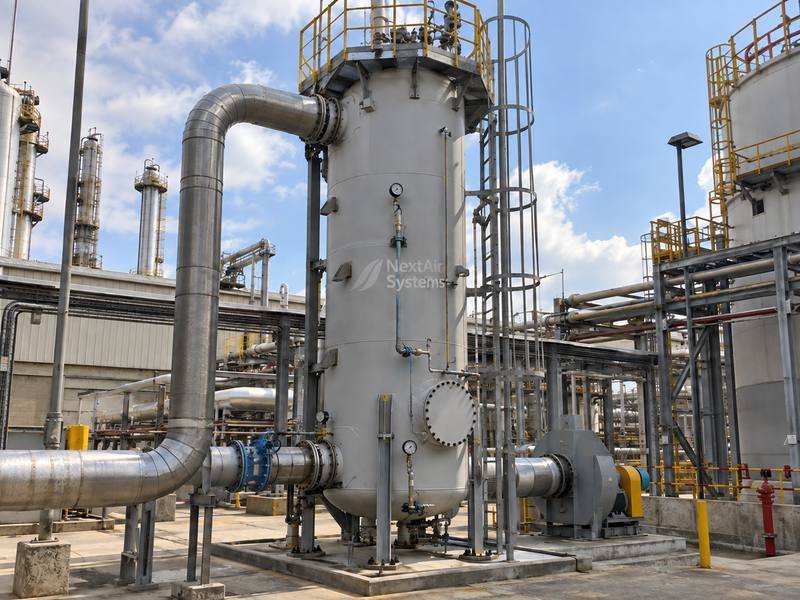
A dry VOC adsorber captures volatile organic compounds from an exhaust air stream using solid activated carbon media, no water or liquid chemicals involved — and depending on how it’s configured, it can either destroy those compounds outright or recover them as reusable solvent. For facilities running paint booths, printing operations, chemical processing, or any solvent-heavy process, getting this technology choice right has real cost and compliance implications.
How VOC Adsorption Works
Activated carbon captures VOC molecules primarily through physical adsorption — intermolecular forces draw organic molecules into the carbon’s vast internal pore network, which offers roughly 800–1,200 m² of surface area per gram. Unlike hydrogen sulfide, which often needs chemically impregnated carbon to react and neutralize it, most VOCs are captured effectively through this physical mechanism alone, on a broader-pore carbon selected for organic compound capture.
As the carbon bed saturates, it needs to be either replaced or regenerated — which is the central design decision in any VOC adsorber system.
Non-Regenerative vs. Regenerative Systems
| Factor | Non-regenerative (throwaway) | Regenerative |
|---|---|---|
| Typical VOC loading | Below ~10 tonnes/year | Above ~10 tonnes/year |
| Capital cost | Lower | Higher |
| Lifecycle cost at scale | Higher (recurring carbon replacement) | Lower once loading justifies it |
| Solvent recovery possible? | No | Yes |
| Best fit | Lower-volume, intermittent processes | High-volume, continuous processes |
Non-regenerative (throwaway) adsorbers use the carbon once, then replace it when saturated. This is generally the more economical choice for lower VOC loading — typically below roughly 10 tonnes of total VOC mass per year — where the cost of periodic carbon replacement is lower than the capital cost of a regeneration system.
Regenerative systems desorb the captured VOCs from the carbon bed using heat (steam or hot inert gas, typically nitrogen) or vacuum, restoring the carbon’s capacity for reuse rather than disposing of it. Above the roughly 10 tonnes/year threshold, regenerative systems generally win on lifecycle cost despite higher upfront capital investment. Regeneration also opens the door to solvent recovery.
Solvent Recovery: Destruction vs. Reuse
This is the key strategic decision for regenerative systems. Two paths exist:
| Approach | What happens to the VOCs | Solvent value | Best fit |
|---|---|---|---|
| Destructive abatement | Oxidized into CO₂ and water | Lost entirely | Compliance-only, low-value or mixed solvents |
| Solvent recovery | Condensed, separated, reused or resold | Recovered, often 99%+ efficiency | High-value, chemically stable single solvents |
Destructive abatement. The captured VOCs are oxidized (via thermal or catalytic oxidation) into CO₂ and water — effective for compliance, but the solvent value is lost entirely.
Solvent recovery. Steam or nitrogen regeneration desorbs the VOCs, which are then condensed and separated (often via distillation for water-organic separation), recovering the solvent as a reusable or resaleable product rather than destroying it. Well-designed solvent recovery systems routinely achieve recovery efficiencies above 99%, turning what would otherwise be a pure compliance cost into a genuine material recovery operation — particularly valuable for high-value solvents used at industrial scale.
Choosing the Right Activated Carbon
Not all activated carbon is interchangeable, and the source material genuinely affects performance for VOC applications specifically:
Coconut shell carbon offers a predominantly microporous structure with high hardness and low ash content, generally favored for VOC applications because its pore size distribution matches typical VOC molecule sizes well, and its hardness reduces dust generation and attrition losses over repeated regeneration cycles.
Coal-based carbon (bituminous or lignite) typically offers a broader pore size distribution spanning micro-, meso-, and macropores, making it more versatile across a wider range of contaminants but not always as precisely matched to VOC-specific capture as coconut shell carbon.
Iodine number, a standard measure of a carbon’s adsorption capacity based on its ability to adsorb iodine from solution, is commonly used as a proxy for microporosity and general adsorptive capacity when comparing carbon products — a truly useful spec to request from any carbon supplier, though it should be considered alongside pore size distribution data specific to your target VOCs rather than as a single definitive quality metric.
Fire and Explosion Safety: A Real Engineering Constraint, Not an Afterthought
Activated carbon beds loaded with adsorbed solvent represent a genuine fire and explosion hazard that needs to be engineered for from the outset, not addressed after the fact:
Bed temperature monitoring matters because activated carbon can catalyze exothermic oxidation reactions with certain adsorbed compounds (particularly ketones and some unsaturated solvents), and a temperature excursion in a solvent-loaded bed can progress to a genuine fire risk if not caught early — temperature sensors throughout the bed, not just at the outlet, are standard practice for a properly engineered system.
Regeneration atmosphere control is why nitrogen (inert gas) regeneration is often specified over steam for certain solvent classes — keeping the regeneration loop outside the flammable envelope by excluding oxygen avoids creating an ignitable atmosphere inside the vessel during the exact process step where desorbed solvent vapor concentration is highest.
LEL (Lower Explosive Limit) monitoring in both the process air stream and the regeneration loop is standard practice for facilities handling solvents with a meaningful flammability risk, providing an active safety interlock rather than relying on design margins alone.
Where Dry VOC Adsorbers Are Used
Paint and coating operations. Spray-painting and baking processes, especially in automotive and industrial coating lines, release solvent-laden air that’s a textbook application for carbon adsorption, often with solvent recovery given the volumes involved.
Printing and packaging. Solvent-based inks and coatings generate VOC emissions requiring the same adsorption-based control.
Chemical and pharmaceutical manufacturing. Solvent handling, reaction vessels, and process venting across chemical manufacturing generate VOC streams needing dedicated capture.
General industrial and warehouse ventilation. Facilities storing or handling solvent-based products may need VOC control even without an active production process generating emissions.
Key Specification Factors
- VOC mass loading (tonnes/year) — the single biggest factor in choosing non-regenerative vs. regenerative technology.
- Solvent value and recoverability — high-value, chemically stable solvents justify recovery investment; mixed or low-value streams may not.
- Regeneration method — steam regeneration is well-established and effective for many solvents; nitrogen (inert gas) regeneration avoids introducing water into the recovered solvent stream and keeps the regeneration loop outside the flammable envelope, which matters for certain solvent classes.
- Regulatory framework — VOC emissions compliance requirements vary significantly by jurisdiction and should be confirmed directly with local environmental authorities before finalizing a system design.
Specification Checklist Before You Buy
- Calculate your actual annual VOC mass loading rather than assuming — this single number determines whether non-regenerative or regenerative technology makes economic sense.
- Confirm whether your solvent has genuine recovery value — high-value, chemically stable single solvents justify recovery investment; mixed or low-value streams often don’t.
- Request iodine number and pore size distribution data from any carbon supplier, matched against your specific target VOC compounds rather than accepting a generic “activated carbon” spec.
- Confirm fire and explosion safety design — bed temperature monitoring, regeneration atmosphere control, and LEL monitoring should be part of the base specification, not an add-on.
- Verify applicable regulatory requirements directly with local environmental authorities before finalizing system design, since VOC compliance thresholds vary significantly by jurisdiction.
Specify the Right VOC Adsorber for Your Process
Whether you need compliance-focused abatement or full solvent recovery, NextAir Systems can recommend the right dry adsorption configuration. Contact us / Request a quote for a process-specific recommendation.
Frequently Asked Questions
When does solvent recovery make more sense than destructive VOC abatement?
Generally when the captured solvent has real reuse or resale value and can be recovered at high purity — for lower-value or mixed solvent streams, destructive oxidation is often simpler and more cost-effective despite losing the material value.
What's the VOC loading threshold for choosing regenerative over non-regenerative adsorption?
Non-regenerative systems are typically more economical below roughly 10 tonnes of total VOC mass per year; above that, a regenerative system generally wins on lifecycle cost despite higher upfront investment.
Does VOC adsorption use the same media as hydrogen sulfide odor control?
Not exactly — most VOCs are captured primarily through physical adsorption on a broad-pore activated carbon, while hydrogen sulfide often requires chemically impregnated carbon to react and neutralize it, meaning a system targeting both needs media selected for each.
Is activated carbon VOC adsorption a fire risk?
It's a genuine engineering consideration that needs active management — solvent-loaded carbon beds can be susceptible to exothermic reactions with certain compound classes, which is why bed temperature monitoring, inert-gas regeneration atmospheres, and LEL monitoring are standard practice on properly engineered systems, not optional extras.
Does the type of activated carbon matter for VOC capture?
Yes — coconut shell carbon's predominantly microporous structure generally suits typical VOC molecule sizes well and resists attrition better over repeated regeneration cycles, while coal-based carbon offers broader versatility across contaminant types; the right choice depends on your specific target compounds.
What's a reasonable recovery efficiency to expect from a solvent recovery system?
Well-designed systems routinely achieve recovery efficiencies above 99%, though actual performance depends on the specific solvent's properties and how well the regeneration and condensation stages are matched to it.
Talk to Our Engineering Team
Call +91-9311805618 or use our contact form for a facility-specific recommendation.
Contact Us