
Ethylene Scrubbers: Extending Storage Life for Climacteric Fruit
An ethylene scrubber removes a gas the fruit itself produces — and that’s exactly what makes controlled atmosphere fruit storage possible for months rather than weeks. Apples, pears, kiwifruit, bananas, mangoes, avocados, and tomatoes all release ethylene as they ripen, and that ethylene accelerates ripening in everything else nearby, including the fruit that produced it. Without continuous ethylene removal, no amount of refrigeration or humidity control alone can hold a climacteric crop in storage for an extended season. This guide covers the chemistry behind ethylene scrubbing, how it fits into a properly designed controlled atmosphere (CA) storage system, how it compares to newer ripening-inhibition technology, and what actually determines correct sizing for a given storage room and crop.
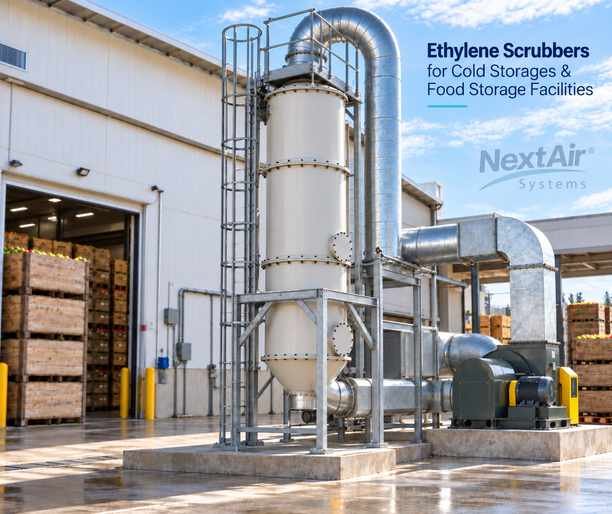
Understanding Climacteric Ripening and Autocatalytic Ethylene Production
Not all fruit ripens the same way after harvest, and that distinction is the entire reason ethylene scrubbing exists as a technology. Climacteric fruits — apples, pears, bananas, avocados, mangoes, tomatoes, kiwifruit, peaches, plums, apricots, and melons among them — continue ripening after they’re picked, driven by a sharp rise in their own respiration rate and a burst of ethylene production known as the climacteric peak. Critically, this process is autocatalytic: ethylene triggers the fruit’s own ethylene biosynthesis pathway to produce more ethylene, which triggers still more, in a self-reinforcing cycle that accelerates softening, color change, starch-to-sugar conversion, and eventual senescence.
Non-climacteric fruits — citrus, grapes, strawberries, pineapple, and cherries — don’t exhibit this autocatalytic ripening burst and produce comparatively little ethylene of their own. They can still be damaged by *external* ethylene exposure (citrus rind degreening and premature softening are common examples), but they don’t drive their own runaway ripening the way climacteric fruit does. This is why ethylene scrubbing is specifically a climacteric-fruit technology: for a crop that doesn’t produce meaningful ethylene and doesn’t respond to it with accelerated ripening, scrubbing capacity is largely irrelevant to storage life.
The practical consequence for storage design is that a sealed room holding climacteric fruit becomes its own ethylene source over time. Every hour the fruit sits in that room, respiration continues, ethylene accumulates, and — without active removal — that accumulated ethylene accelerates the very ripening the storage operation is trying to delay. This is the mechanism ethylene scrubbing exists to interrupt.
Why Ethylene Removal Is Different From Every Other Product on This Site
Every other odor and gas control product we cover exists to eliminate an unwanted compound generated by an external industrial process. An ethylene scrubber is different: it’s removing a compound the stored product itself continuously generates, as part of its normal biology, specifically to prevent that product from triggering its own premature ripening and that of everything stored alongside it. Get the ethylene removal wrong, and the fruit ripens and softens on schedule regardless of how well the temperature and humidity are controlled — refrigeration and humidity management address two separate variables, but neither one touches the ethylene accumulation problem directly.
How Ethylene Scrubbing Works: Chemistry and Media
The dominant commercial technology is potassium permanganate (KMnO₄) oxidation. Ethylene gas passing over KMnO₄-impregnated media is oxidized into carbon dioxide and water, while the permanganate itself is reduced to manganese dioxide (MnO₂) in the process. The media is typically impregnated onto a porous, high-surface-area carrier — activated alumina, zeolite, or a silica-based substrate — chosen specifically to maximize the contact surface area between the gas stream and the active permanganate coating, since the reaction can only occur where ethylene molecules physically contact unreacted KMnO₄.
This reaction produces a genuinely useful practical side effect: as permanganate converts to manganese dioxide, the media visibly changes color from purple to brown. That color shift is a direct, real-time visual indicator of consumed capacity — media that has fully converted to brown has exhausted its ethylene-oxidizing capacity and needs replacement, giving facility operators a straightforward field check without requiring lab analysis or gas sensor calibration.
Alternative and complementary technologies exist, each with different capacity, cost, and maintenance characteristics:
Activated carbon adsorption physically adsorbs ethylene onto the carbon’s porous surface rather than chemically destroying it. This approach has lower capacity per unit volume than KMnO₄ oxidation for ethylene specifically, since activated carbon’s affinity for a small, non-polar molecule like ethylene is weaker than its affinity for larger, more complex VOCs — but it can serve as a useful secondary or polishing stage.
Catalytic and photocatalytic (UV-TiO₂) oxidation systems use a catalyst, sometimes combined with UV light, to break down ethylene at the catalyst surface without consuming a stoichiometric reagent the way KMnO₄ does. These systems can offer longer service intervals since the catalyst itself isn’t chemically consumed, though they typically carry higher upfront equipment cost and depend on adequate residence time and airflow across the catalyst surface for effective conversion.
Ozone-based systems generate ozone to oxidize ethylene, but require careful dosing and monitoring given ozone’s own toxicity and regulatory exposure limits — a genuine consideration for any facility evaluating this approach, since worker safety near the storage room becomes a design constraint in a way it isn’t with enclosed KMnO₄ media beds.
Ethylene Sensitivity Thresholds and Why “Trace Amounts” Matter
One of the most counterintuitive aspects of ethylene physiology is just how little gas is needed to trigger a measurable ripening response. Climacteric fruit can respond to ethylene concentrations in the sub-part-per-million to low single-digit part-per-million range — concentrations far below what would register as a detectable smell or an obvious air quality concern in almost any other industrial context. This sensitivity is precisely why “mostly controlling” ethylene in a CA storage room isn’t an adequate strategy: because the ripening response is dose- and time-dependent, even a persistently low background concentration, sustained over weeks or months of storage, can measurably shorten a crop’s storage life compared to a room where ethylene is held reliably near zero.
This is also why scrubber capacity needs continuous, sustained performance rather than periodic or intermittent operation. A scrubber that removes ethylene effectively when media is fresh but loses effective capacity partway through a storage season — without an operator noticing the color-change warning sign — can allow ethylene to climb back into a ripening-relevant range well before the crop was scheduled to come out of storage.
How Ethylene Scrubbing Fits Into Controlled Atmosphere Storage
Ethylene removal doesn’t work in isolation — it’s one of three coordinated systems in a serious controlled atmosphere storage room, and each addresses a truly distinct part of the ripening physiology:
Refrigeration slows the fruit’s respiration rate and overall metabolic activity, since virtually every biological process involved in ripening, including ethylene biosynthesis itself, runs faster at higher temperature.
Controlled atmosphere gas management — typically reduced oxygen (often in the range of 1-3% for ultra-low-oxygen storage, versus roughly 21% in ambient air) and elevated CO₂ relative to normal air — further suppresses respiration and slows the ethylene biosynthesis pathway at the cellular level, independent of temperature.
Ethylene scrubbing removes the ripening hormone itself, continuously, while the room remains sealed for the storage season, directly interrupting the autocatalytic cycle described above rather than merely slowing the metabolic processes that drive it.
Together, these three systems hold a climacteric crop in something close to its harvest-day condition for months rather than weeks. Remove any one — including ethylene control — and the other two can’t fully compensate; ethylene will still accumulate and drive ripening even in a cold, low-oxygen room, because low temperature and low oxygen slow ethylene *production* without eliminating the ethylene that’s already present or continuing to be produced at a reduced rate.
Ethylene Scrubbing Versus 1-MCP: Two Different Mechanisms
A meaningfully different approach to the same underlying problem has become widespread in commercial fruit storage over the past two decades: 1-methylcyclopropene (1-MCP), typically applied as a one-time gas treatment shortly after the fruit enters storage. Rather than removing ethylene from the room’s atmosphere, 1-MCP works by binding to the fruit’s own ethylene receptors, blocking the fruit from responding to whatever ethylene is present — including ethylene the fruit itself continues to produce.
| Factor | Ethylene scrubbing (KMnO₄) | 1-MCP |
|---|---|---|
| Mechanism | Removes ethylene gas from room air | Blocks fruit’s ethylene receptors |
| Application | Continuous, for full storage duration | One-time treatment at intake |
| Effect over long storage | Stays constant as long as media is active | Can diminish as new receptors form |
| Best used | Throughout the storage season | At intake, often alongside scrubbing |
This is a distinctly different mechanism from ethylene scrubbing, and the two technologies are frequently complementary rather than competing. 1-MCP’s receptor-blocking effect can diminish over an extended storage period as new, unblocked receptors form, meaning long-duration storage often still benefits from active ethylene scrubbing to keep ambient concentrations low throughout the full season, even where 1-MCP has already been applied. Facilities running the longest storage durations — multi-month apple and pear programs in particular — commonly use both: 1-MCP treatment at intake, and continuous ethylene scrubbing for the duration of the storage period, rather than treating the two as interchangeable alternatives.
Sizing an Ethylene Scrubber
Scrubber capacity needs to be matched to factors specific to your storage operation, not a generic room-size assumption:
Room volume and air change rate, determining the airflow needed to cycle the room’s full air volume through the scrubber media at a frequency sufficient to keep ambient ethylene concentration below the crop’s sensitivity threshold, rather than simply matching room size to a generic equipment capacity rating.
Crop ethylene production rate, which varies significantly by fruit type, variety, ripeness stage at the time of storage, and even growing-season conditions. Apples and pears are generally moderate-to-high ethylene producers; bananas and avocados can produce very high rates once their own climacteric ripening begins; tomatoes and kiwifruit vary considerably by cultivar and maturity at harvest. A room full of a highly ethylene-productive variety needs meaningfully more scrubbing capacity than the same volume storing a lower-ethylene crop, even at identical fruit mass.
Storage duration, since the scrubber operates continuously while the room stays sealed for the full storage season. Media replacement scheduling for KMnO₄-based systems needs to be planned against total *expected cumulative ethylene load* for the entire storage duration, not just the room’s initial capacity — a longer planned storage period requires either higher initial media capacity, a scheduled mid-season media change, or both.
Room sealing and infiltration, since a room that isn’t well-sealed against outside air exchange complicates both the controlled-atmosphere gas management and the ethylene scrubbing calculation, as uncontrolled infiltration introduces both oxygen (undermining the CA gas targets) and, in mixed-storage facilities, potentially ethylene from other rooms or areas.
Specify the Right Ethylene Scrubber for Your Storage Operation
Whether you’re designing a new controlled atmosphere storage room or addressing premature ripening in an existing one, NextAir Systems can recommend the right ethylene scrubbing capacity for your crop, room volume, and planned storage duration. Contact us / Request a quote for a facility-specific recommendation.
Frequently Asked Questions
How do I know when ethylene scrubber media needs replacing?
For potassium permanganate media, the color change from purple to brown is a direct visual indicator of consumed capacity — media that has fully converted to brown has exhausted its ethylene-oxidizing capacity and needs replacement, and this visual check should be part of routine storage room monitoring rather than relying solely on a calendar-based replacement schedule.
Can refrigeration alone control ripening without an ethylene scrubber?
No — refrigeration slows respiration and metabolic activity, including the rate of ethylene production, but it doesn't remove the ethylene gas the fruit itself continues to produce, which will still accumulate in a sealed room and drive ripening even at low temperature, since the underlying autocatalytic biosynthesis pathway continues to operate, just more slowly.
Which crops need ethylene scrubbing most?
Climacteric fruits — those that continue ripening after harvest via an autocatalytic ethylene burst, including apples, pears, kiwifruit, bananas, mangoes, avocados, and tomatoes — benefit most from active ethylene control during extended storage, while non-climacteric crops like citrus, grapes, and strawberries generally see less benefit from dedicated scrubbing capacity.
Does 1-MCP treatment eliminate the need for an ethylene scrubber?
Not for extended storage durations — 1-MCP blocks the fruit's ethylene receptors rather than removing ambient ethylene, and its receptor-blocking effect can diminish over a long storage season as new receptors form, meaning many multi-month storage programs use both 1-MCP at intake and continuous ethylene scrubbing throughout storage rather than treating them as substitutes for one another.
How low does ethylene concentration need to be to actually matter?
Climacteric fruit can respond to ethylene in the sub-part-per-million to low single-digit part-per-million range, meaning "mostly controlling" ethylene isn't an adequate target — sustained low-level ethylene exposure over weeks or months of storage can measurably shorten storage life even when concentrations never reach a level that would be noticeable by smell.
Can a single ethylene scrubbing system serve multiple storage rooms?
Generally not effectively for sealed CA rooms — each room needs to maintain its own controlled atmosphere independently, and cross-connecting ethylene scrubbing between rooms risks compromising the individual oxygen and CO₂ targets each room is managing, so dedicated, room-specific scrubbing capacity is the standard approach for serious multi-room CA storage facilities.
Talk to Our Engineering Team
Call +91-9311805618 or use our contact form for a facility-specific recommendation.
Contact Us